
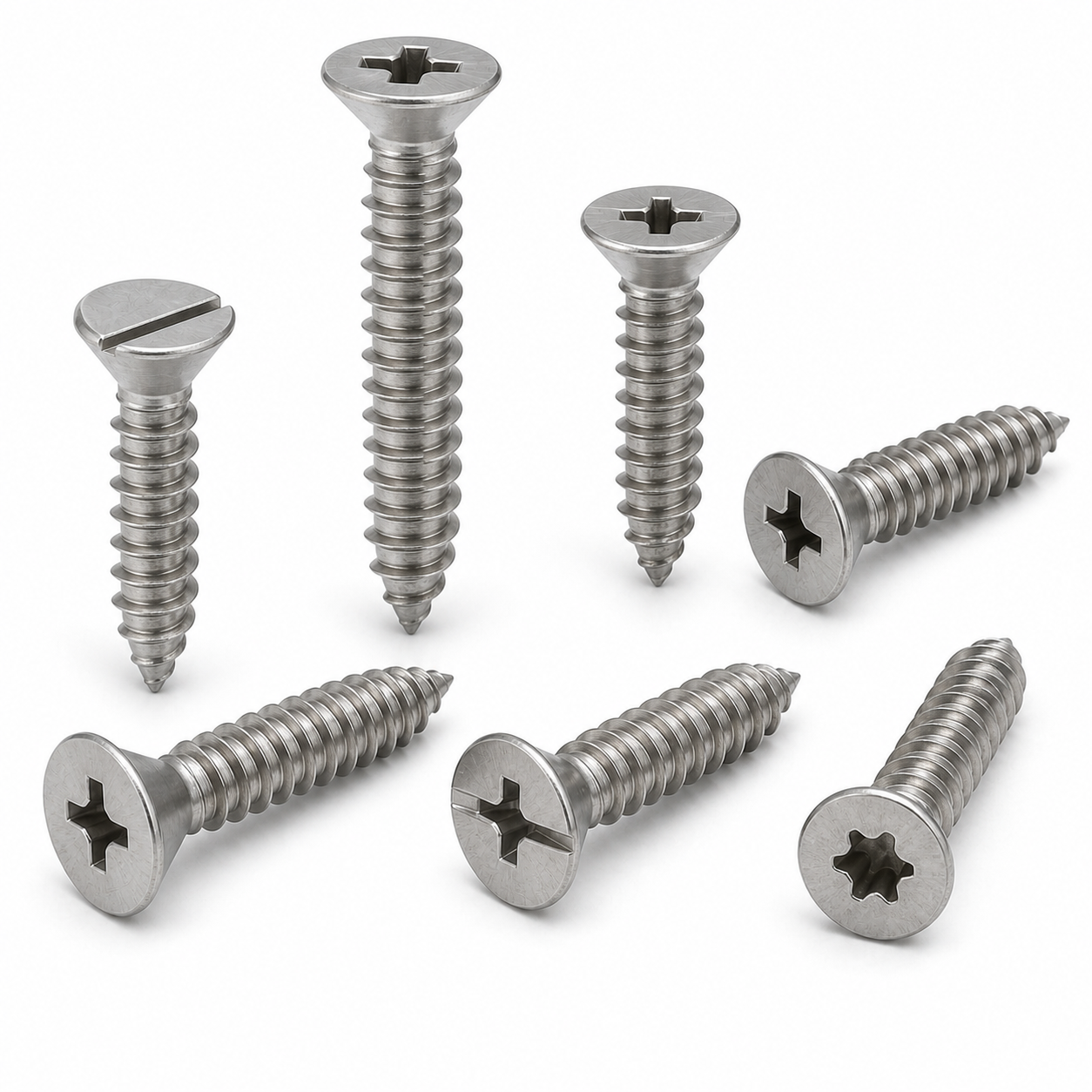
Countersunk Head Self Tapping Screws
Stainless Steel Flat Head Self Tapping Screws for Flush Sheet Metal Assembly
Countersunk Head Self Tapping Screws, also called Flat Head Self Tapping Screws, form a mating thread in a suitable prepared sheet-metal or fabricated component while seating in a matched countersink. Their flat top can remain flush or near-flush with the surrounding surface. VALTOR supplies stainless and carbon steel versions with cross-recessed, slotted, combination and 6-lobe drives.
Product Overview
A Countersunk Head Self Tapping Screw forms its mating thread in a suitable prepared component. Unlike a machine screw, it does not require a fully pre-threaded nut or tapped hole. Unlike a self drilling screw, it has no integrated drill point for creating the initial hole.
The conical head underside seats in a countersunk feature. Correct flush positioning depends on head diameter and angle, countersink diameter, angle and depth, component thickness and alignment. A shallow countersink may leave the head proud; excessive depth may place it below the intended surface; mismatched angles can produce inconsistent bearing contact.
Purchasing variables include ST thread size, top-to-tip length, non-drill point or thread-end, pilot hole, substrate, sheet thickness, drive, material, finish, governing standard and OEM drawing. Standard and custom supply must follow the actual dimensional and installation requirements rather than assuming one configuration works for every material.
Technical Specifications
Countersunk Fit, Tapping Thread & Pilot Hole Selection
Material, Size & Finish Options
Longer lengths apply to suitable larger diameters; the page does not imply that every ST diameter is commercially paired with every length.
Drive, Point & OEM Manufacturing
Point geometry follows the applicable standard, customer drawing, substrate and pilot-hole condition. Pointed, cone-start or alternative standard non-drill forms may apply.
Custom parameters may include ST diameter, length, head dimensions, drive and recess, point, material and finish. Provide drawing or sample, thread, length, drive, sheet material, thickness, pilot hole, quantity and application.
Inner bags, boxes, export cartons, pallets, customer labels, part numbers and authorized private-label packaging may be supported.
Installation Validation, Quality & Documentation
Inspection checks thread diameter, pitch, profile and continuity; point formation and damage; head diameter, height, countersunk geometry and concentricity; recess geometry, depth, position, burrs and driver engagement; and top-of-head to end length. Customer parts, drawings or approved test pieces may validate countersink fit, starting, tapping behavior, flush position, material deformation and stripping under defined conditions. Documentation may include MTC, raw-material, dimensional, product or actually performed sample-test reports and specified third-party support without invented torque values.
Applications
Flush direct-tapping fastening for prepared industrial sheet-metal components.
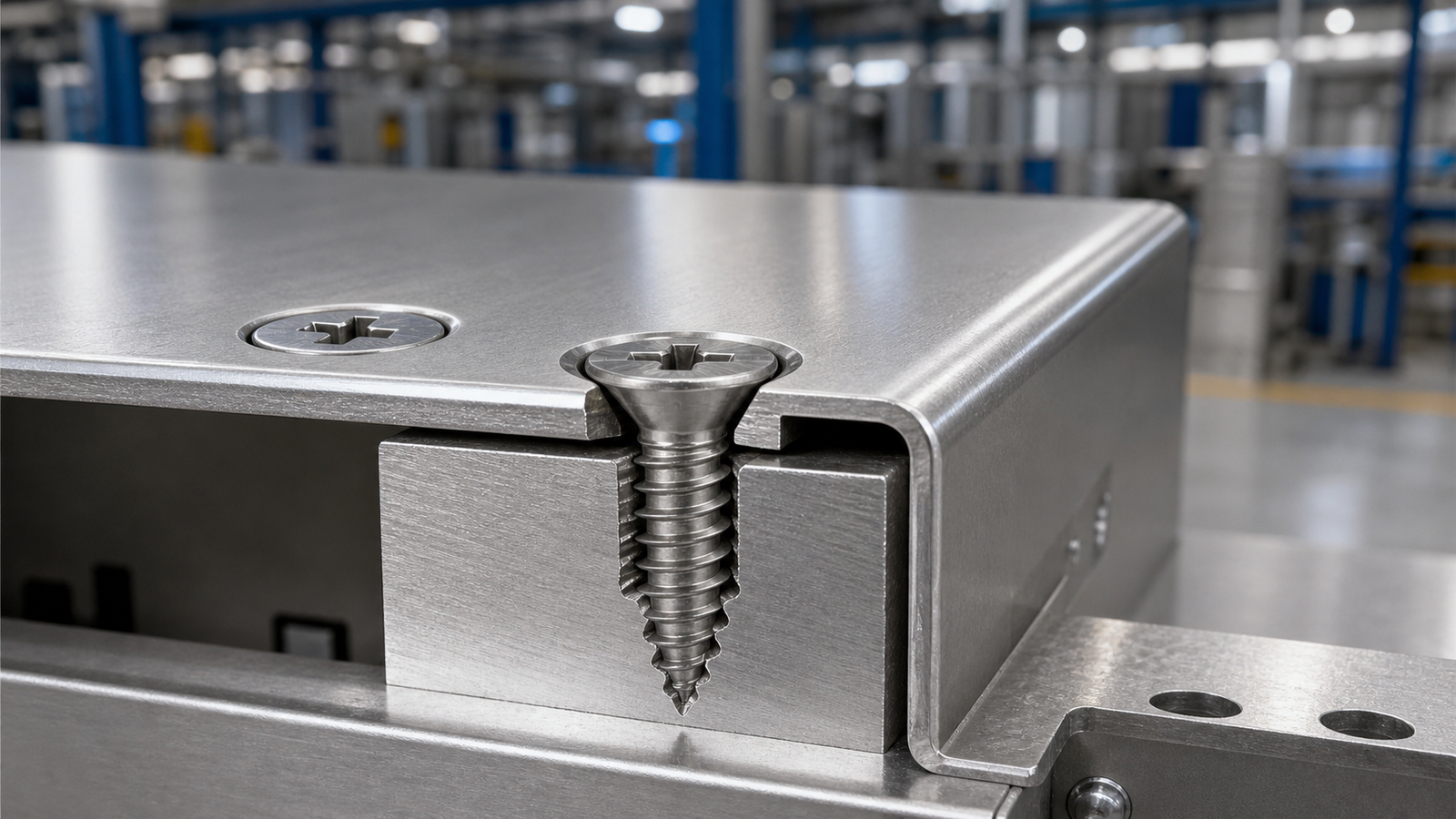
Flush self-tapping fastening for removable metal covers and machinery panels.
Cabinets and control boxes where protruding screw heads should be minimized.
The tapping thread forms its mating thread directly in suitably prepared sheet metal.
Fabricated components requiring countersunk seating and direct tapping fastening.
Drawing-based assemblies requiring controlled surface position, tapping performance and flush installation.
Frequently Asked Questions
What is the difference between DIN 7982 and ISO 7050?
DIN 7982 is a legacy / withdrawn purchasing standard for cross-recessed countersunk tapping screws, while ISO 7050 is the relevant current ISO standard. Buyers should specify the exact requirement because dimensional details can differ.
What is the difference between Countersunk Self Tapping and Countersunk Machine Screws?
A countersunk machine screw requires an existing female thread. A countersunk self tapping screw forms its mating thread in a suitable prepared component.
What sizes can VALTOR supply?
Common supply covers ST2.2–ST9.5 with lengths approximately 4.5–120 mm depending on diameter, material and standard. Not every diameter is normally paired with every length.
How do I select the pilot hole?
Pilot-hole size depends on screw diameter, thread geometry, substrate, thickness and hardness. Select it from the applicable standard, drawing or validated test rather than one universal value.
Can stainless steel Countersunk Self Tapping Screws be customized?
Yes. Feasible custom requirements may include ST diameter, length, drive, non-drill point, head dimensions, material, finish and packaging. Sheet material, thickness and pilot-hole data are useful for OEM review.
Related Products
Share the standard or drawing, ST size, top-to-tip length, drive, point, countersink, material, finish, substrate, thickness, pilot hole and quantity with VALTOR.