
When Standard Fasteners Are No Longer the Right Solution
Not every project that falls outside a standard catalogue needs a fully custom fastener. In many cases, a standard product with a controlled secondary operation can solve the requirement more efficiently. In other situations, the geometry, material, assembly method or functional requirement means that forcing a standard fastener into the application creates more risk than developing the correct custom solution. The key decision is not simply “standard or custom?” It is: what is the simplest manufacturing route that can reliably meet the actual function, quantity and service requirement? This article explains how experienced buyers and engineers evaluate that decision before committing to tooling or production.
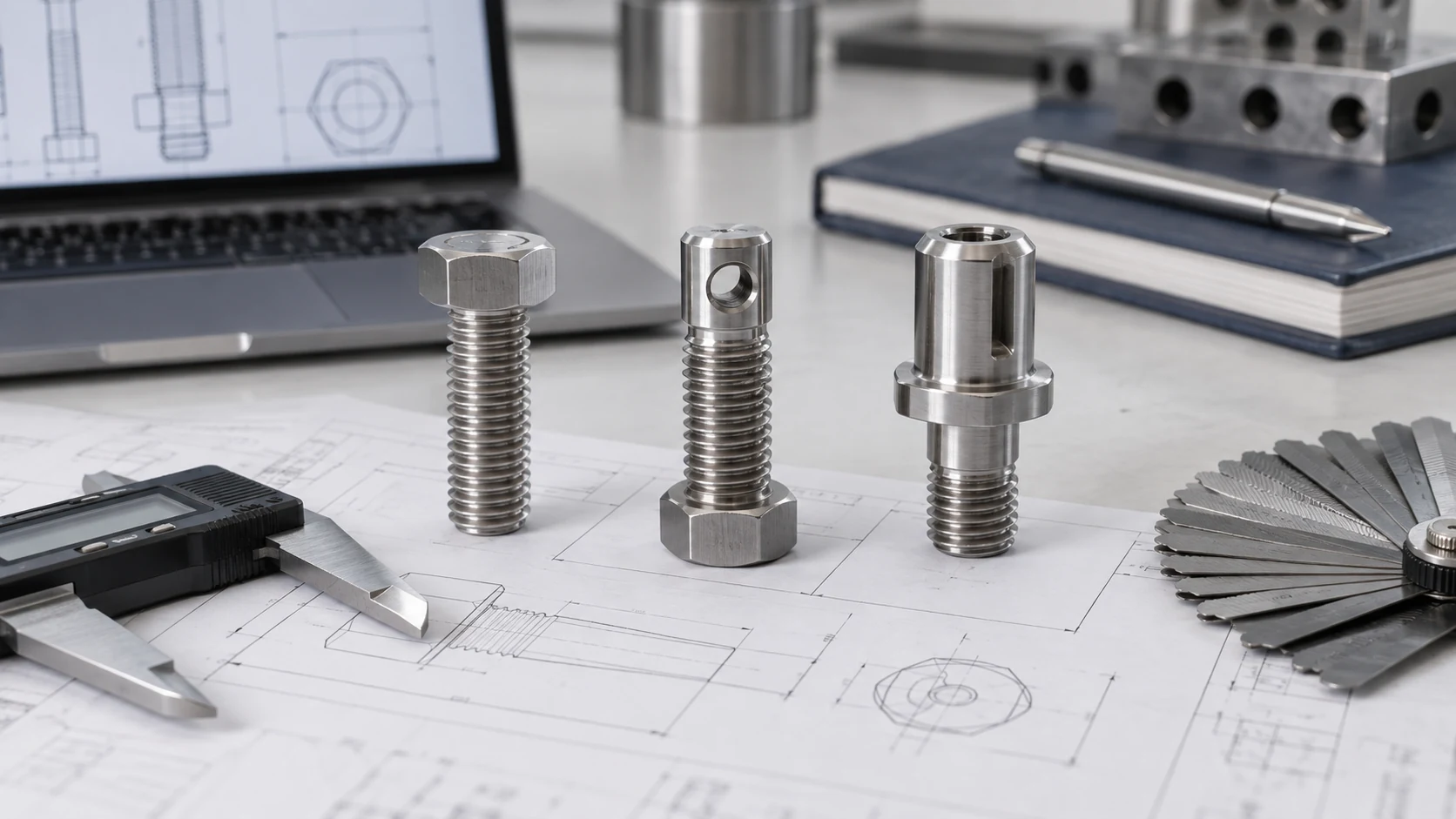
1. Start With the Function, Not the Catalogue
Before searching for a standard or custom fastener, define what the part must actually do. The joint may need to clamp two components, locate or position a part, provide controlled shoulder engagement, prevent rotation, allow movement, retain another component, fit restricted installation space, provide sealing or a controlled bearing area, or carry a specific assembly feature.
A catalogue search is useful only after the functional requirements are clear. Selecting the closest available geometry without understanding the joint can create extra components, difficult assembly or poor control of the critical interface. The fastener should be selected around the function of the joint, not only around the closest catalogue shape.
Key Takeaways
- Standard fasteners should remain the first choice when they meet the actual function.
- Small changes do not always require a fully custom part.
- Modified standard fasteners can often reduce complexity.
- Fully custom geometry should solve a real functional, assembly or manufacturing requirement.
- Material, quantity and production method can change which solution is most practical.
- A drawing that is easy to design may still be difficult or inefficient to manufacture.
2. Three Possible Routes: Standard, Modified Standard or Fully Custom
Standard Fastener
Use a standard product when standard dimensions already satisfy the joint, available material options suit the service conditions, installation and function are conventional, and no special feature is required. This is normally the simplest route because the geometry and manufacturing method are already established.
Modified Standard Fastener
A standard base product can be suitable but still require a controlled secondary operation. Depending on the product and application, this may include a custom length, reduced thread length, cross hole, drilled hole, machined flat, slot, point modification, localized machining, a pre-applied thread-locking patch or special packaging and marking.
Fully Custom Fastener or Hardware
Custom geometry becomes relevant when the shape directly controls function: standard head or shank geometry cannot work, locating or anti-rotation features are needed, shoulder dimensions control movement or position, installation space requires a special form, or several functions must be integrated into one component.
Choosing the Right Starting Point
| Situation | Better Starting Point |
|---|---|
| Standard dimensions already meet the joint requirement | Standard fastener |
| Only length, hole, slot or localized feature changes | Modified standard product |
| Geometry directly affects function or assembly | Custom fastener |
| Special material combined with complex geometry | Manufacturing review first |
| Low quantity with complex geometry | Evaluate machining before dedicated tooling |
| Repeat production with suitable geometry | Review forming / tooling route |
3. Modified Standard Products Are Often the Most Efficient Solution
There is a large middle ground between catalogue products and fully custom parts. When the standard product already provides the correct structural geometry and assembly interface, a controlled secondary operation can solve a limited requirement without introducing a completely new primary manufacturing route.
Potential benefits include reduced tooling complexity, use of established standard geometry, easier raw-material sourcing, faster development and simpler repeat ordering. The trade-off is that secondary operations add cost, can affect tolerances or finish, require another inspection stage and may become inefficient as quantity increases.
A modified standard product is most useful when the base fastener already satisfies the main structural and assembly requirements. Secondary operations should solve a limited, clearly defined requirement rather than compensate for a fundamentally unsuitable base product.
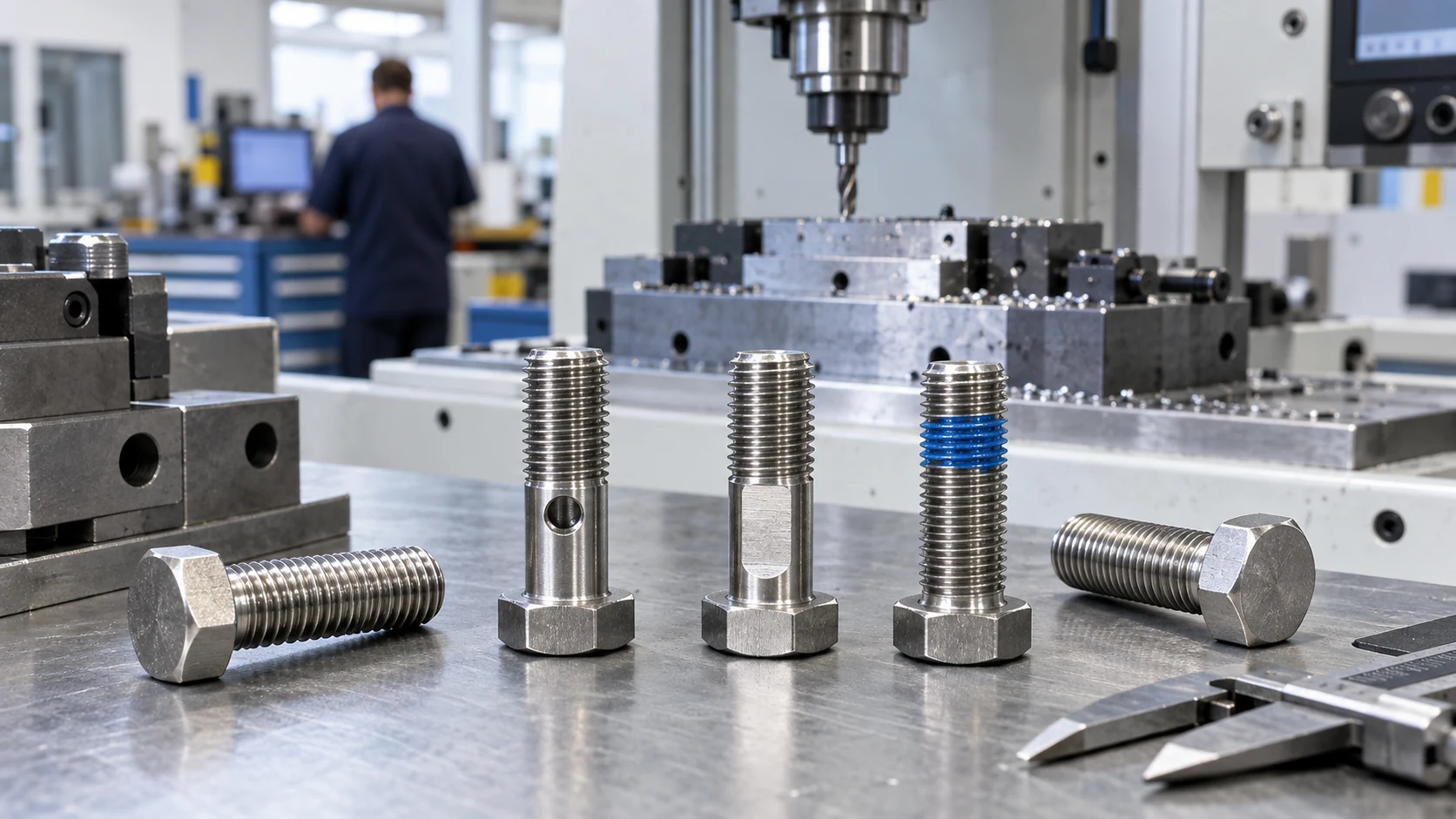
4. When a Standard Fastener Becomes the Wrong Compromise
A close standard part is not automatically the correct engineering solution. A standard head may not fit the installation space, the standard thread length may interfere with assembly, the joint may require a locating shoulder or anti-rotation feature, or the bearing area may not be achievable with a practical washer arrangement.
Other applications may need an integrated retaining feature, controlled movement or spacing, or geometry outside normal standard dimensions. In these cases, forcing the catalogue part into the joint can add adapters, spacers, washers or manual assembly steps while still leaving the main functional requirement poorly controlled.
If multiple additional components, spacers, washers or manual assembly steps are required only to make a standard fastener work, review whether a purpose-designed component could simplify the assembly.
5. A Drawing Can Be Easy to Create but Difficult to Manufacture
CAD makes complex geometry easy to draw. Manufacturing must still account for material flow, tooling access, forming limits, machining access, wall thickness, corner radii, undercuts, deep recesses, long slender geometry and tolerance stack-up.
Very deep socket recesses, extremely thin flanges, sharp internal corners, deep cross holes near threads, long unsupported shoulders, very small wall sections and multi-level head geometry may require a different manufacturing route or a design adjustment. Features requiring several setups can also make repeat control more difficult. These details are not necessarily impossible, but they should be reviewed before the drawing is treated as production-ready.
Design intent should remain unchanged, but small geometry adjustments can sometimes make a part significantly easier to manufacture repeatedly without changing its function.
6. Quantity Can Change the Best Manufacturing Route
The same component may need different manufacturing strategies at different quantities. For a prototype or very low quantity, CNC machining can be practical because it avoids dedicated tooling and enables rapid geometry verification. For repeat or higher-volume production, cold heading, cold forming, forging, stamping or dedicated tooling may become more practical when the geometry and material are suitable.
There is no universal quantity threshold. The decision depends on geometry, material, tolerance, tooling complexity, expected repeat orders and required volume.
How Quantity Can Influence the Manufacturing Route
| Production Situation | Possible Starting Point |
|---|---|
| Prototype / very low quantity | Machining or simplified production route |
| Small repeat order | Machining or modified standard product |
| Medium repeat production | Review forming / machining combination |
| Higher repeat volume | Review dedicated tooling / forming route |
| Complex special alloy part | Manufacturing feasibility review before route selection |
7. Material Choice Can Change the Entire Manufacturing Plan
A geometry that is practical in one material may be considerably more difficult in another. Common grades such as 304 and 316, and special materials including 2205 Duplex, 2507 Super Duplex, 904L, 1.4529 / UNS N08926 and C-276 / UNS N10276, differ in forming and machining behavior as well as availability.
Material choice can affect cold-forming feasibility, machining speed, tooling wear, forging route, available raw-material form and section, sourcing complexity and the practical production strategy. Special alloys are not automatically unsuitable for forming; manufacturing feasibility should be reviewed according to grade, geometry, dimensions, quantity and available material form. See Stainless Steel & Special Alloy Materials for related material guidance.
8. Tolerance Should Follow Function, Not Habit
Custom drawings sometimes apply very tight tolerances to every dimension. This can increase machining and inspection time, restrict manufacturing options and increase cost without improving the product’s actual function. The opposite problem is equally important: a loose tolerance on a critical interface can cause poor assembly, excessive movement, interference or inconsistent positioning.
Critical dimensions should be identified according to fit, function and assembly. General geometry and cosmetic dimensions do not always need the same control as threads, shoulders, bearing interfaces or locating features.
The most useful custom drawing distinguishes between dimensions that control function and dimensions that simply define general geometry.
9. Custom Should Solve a Real Problem
A custom fastener is justified when it creates measurable functional value: reducing component count, improving assembly access, integrating locating features, simplifying installation, controlling spacing, fitting restricted geometry, meeting a special material requirement or improving repeat assembly consistency.
Custom does not automatically mean technically superior. The goal is simpler assembly, correct function, reliable production, suitable material and repeatability. The best solution is the simplest manufacturing route that reliably meets the actual function.
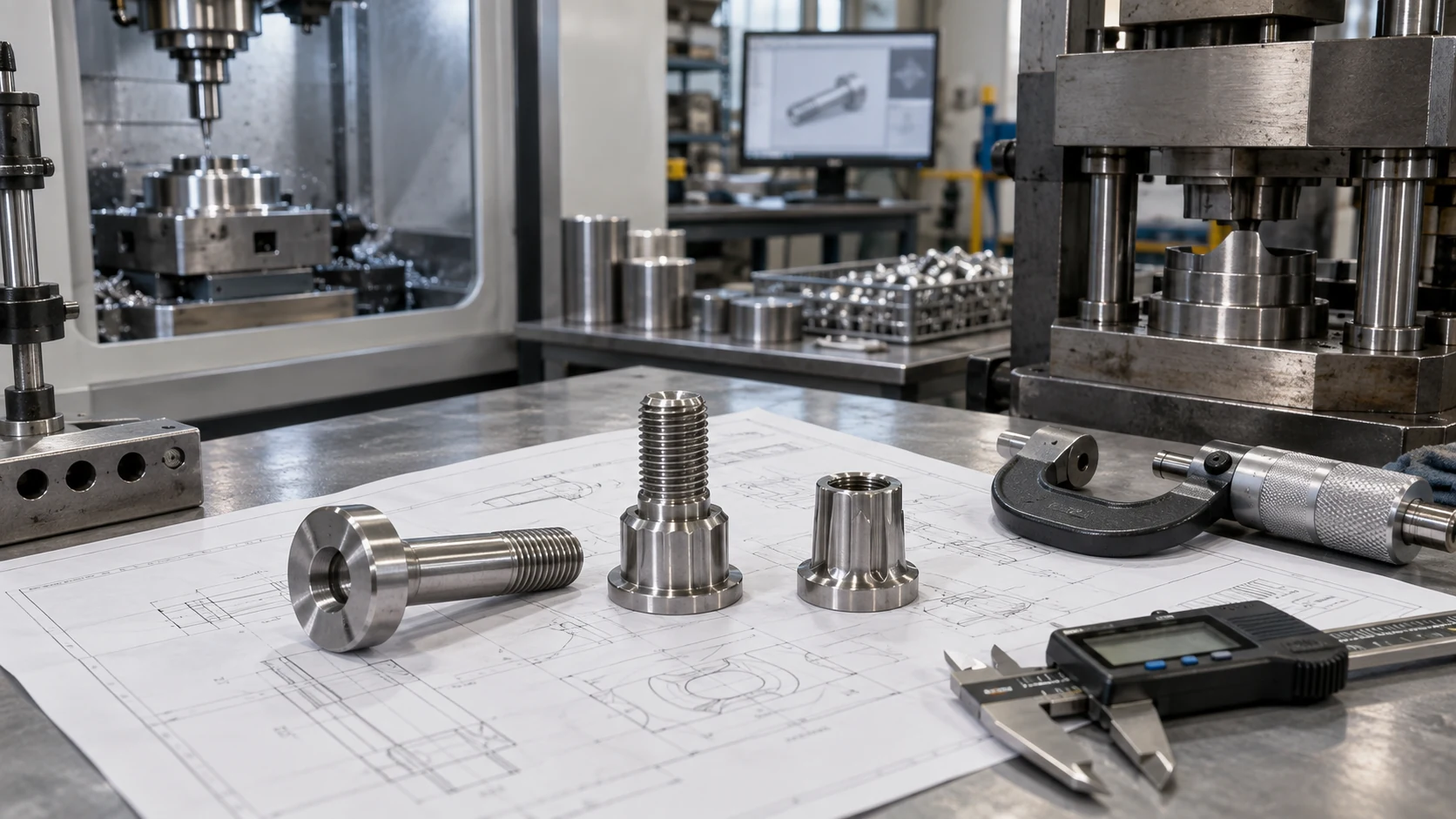
10. Questions to Ask Before Choosing a Custom Fastener
- What function cannot be achieved with a standard product?
- Can a standard fastener be modified instead?
- Which dimensions directly control fit or function?
- What material is required?
- Is the selected material suitable for the proposed manufacturing route?
- What quantity is required now?
- Is repeat production expected?
- Are any special tolerances truly necessary?
- Does surface treatment affect dimensions or assembly?
- What inspection and documentation are required?
These questions help define whether the project needs a catalogue fastener, a modified standard part or a fully custom component.
FAQ
When should I use a custom fastener instead of a standard fastener?
A custom fastener is most appropriate when the application requires geometry, material, positioning, assembly or functional features that a standard product cannot reliably provide.
Is modifying a standard fastener cheaper than making a custom part?
It can be, but not always. Secondary machining may be efficient for limited changes and lower quantities, while repeat production may justify dedicated tooling or a purpose-designed manufacturing route.
Can any custom fastener be cold headed?
No. Cold forming feasibility depends on material, geometry, dimensions, deformation requirements and production quantity. Some designs may require machining, forging or a combined process.
Why does quantity affect custom fastener manufacturing?
Different production methods have different tooling, setup and repeatability characteristics. A process suitable for a small prototype batch may not be the best route for repeat production.
Can VALTOR review a drawing before production?
Drawing-based requirements can be reviewed for material, geometry, manufacturing route, inspection requirements and production feasibility before quotation or production.
Standard, Modified or Custom?
Send VALTOR your drawing, application, material, quantity and functional requirements for manufacturing review.