
Fully Threaded Rod Specifications: Sizes, Threads, Grades & How to Specify
A practical guide to specifying fully threaded rod: thread designation, material grades, dimensional control and the information an RFQ should carry so the quoted product matches the intended joint.
Overview
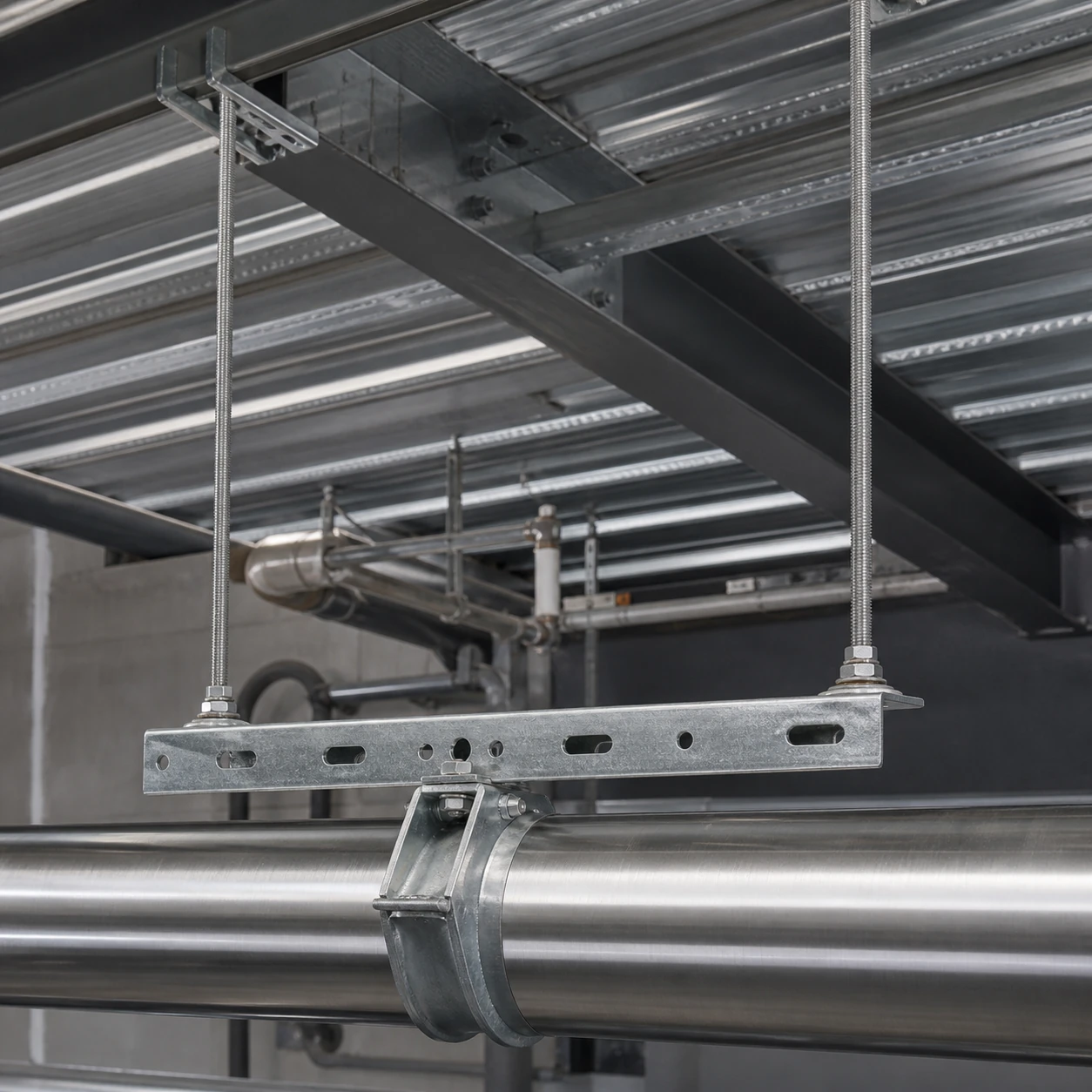
Fully threaded rod, also described in drawings and inquiries as threaded bar, all-thread rod or continuously threaded stud, is a straight bar threaded along its entire length. Used with nuts and washers, it creates adjustable, long-span or through-bolted joints in pipe supports and hanger assemblies, steel fabrication, equipment mounting, facade and cladding support systems, and general industrial assemblies where a standard bolt length is not practical.
Because the product looks simple, it is often specified in a single line such as “M12 stainless threaded rod, 2 m”. That line omits the details that determine whether the delivered rod will actually fit and perform: thread pitch and tolerance class, the governing product standard, material grade and mechanical property class, length and end condition, straightness, surface condition, and the inspection or documentation the project requires. The result is a quote that is easy to compare on price but difficult to compare on specification.
This guide sets out how to specify fully threaded rod so a supplier can quote accurately. It covers product form and terminology, thread designation, the standards commonly referenced, material and mechanical grades, dimensional control, and a practical RFQ checklist. Where a value depends on a drawing, an applicable standard or a specific project requirement, it is identified as such rather than assumed.
Key Takeaways
- Fully threaded rod, double-end stud and stud bolt are different product forms; state which one the drawing requires.
- A complete thread designation includes diameter, pitch and tolerance class. “M12” alone is not a complete specification.
- Material grade and mechanical property class are separate decisions; corrosion resistance and strength are not the same requirement.
- End finish, straightness, thread lead-in and cut-length tolerance are the dimensional details most often missed in an inquiry.
- An RFQ should state the governing standard or drawing, grade, dimensions, surface condition, inspection and documentation requirements.
- Suitability for a specific joint, including any load requirement, must be confirmed by the design and the applicable product data.
What Is a Fully Threaded Rod?
A fully threaded rod carries a continuous thread from one end to the other. It is normally cut to length from longer stock and used with two or more nuts, which makes the assembled length adjustable and allows a single rod to pass through an entire assembly. This is why it is common in hanger and support work, where the vertical position has to be set on site, and in through-bolted connections where a conventional bolt would be too short.
Three related product forms are frequently confused in inquiries:
- Double-end stud has threads at both ends with an unthreaded shank between them. It is selected where the middle section needs a plain bearing surface, a controlled grip length or a specific reduced shank.
- Stud bolt, in the terminology used by bolting specifications such as ASTM A193/A193M, is generally supplied to a defined length for flanged and pressure-containing connections, complete with two nuts.
- Threaded bar is used in some markets as a synonym for fully threaded rod and in others for a coarser construction product. The term alone does not define thread form, tolerance or material.
Because these descriptions are not interchangeable, the safest approach is to reference a revision-controlled drawing or a named product standard rather than a generic product name. VALTOR maintains separate pages for Fully Threaded Rods, Double-End Studs, Stud Bolts and Threaded Bars, which can be used to align terminology before an inquiry is issued.
If a drawing says only “threaded rod”, confirm whether a continuous thread or an unthreaded shank is required. The answer changes both the manufacturing route and the quotation.
Thread Designation & Applicable Standards
For ISO metric threads, a nominal diameter such as M12 identifies the diameter but not the complete thread. Pitch should be stated explicitly, even when a coarse series is intended: coarse-pitch and fine-pitch versions of the same nominal diameter are not interchangeable. ISO 261 defines the general plan for ISO metric screw threads and ISO 262 covers the selected diameter and pitch combinations widely used for screws, bolts and nuts. Where an inch-series project is involved, the thread form and class should be identified in the same way rather than described as “standard thread”.
Thread tolerance is a separate part of the designation. ISO 965-1 defines the tolerance system for general-purpose metric screw threads, and the external thread tolerance class commonly seen on fastener drawings is 6g, with 6H typically used for the mating internal thread. The class affects fit with the nut and with any coating, so it belongs in the specification rather than being left to the supplier to assume.
Product and material standards are also distinct. DIN 976-1 is commonly referenced for threaded rods with metric ISO thread, and the older DIN 975 still appears in legacy drawings. ASTM A193/A193M and ASTM A320/A320M are bolting material specifications for high-temperature, high-pressure and low-temperature service respectively; they define material and mechanical requirements rather than the dimensional form of a continuously threaded rod. ISO 3506-1 covers the mechanical properties of corrosion-resistant stainless steel fasteners. See DIN vs ISO Fastener Standards for how these reference systems differ, and Fastener Property Classes for the meaning of class markings.
Standards are revised. Where a drawing cites a standard without a revision date and a newer edition has since been published, confirm which edition governs before the order is released.
Specification Checklist
The table below lists the parameters that a fully threaded rod specification should define. It is a checklist of what to state, not a list of dimensions or a statement of available sizes. Values come from the drawing, the applicable standard, the project specification and the supplier’s confirmed capability for the order in question.
| Item to specify | What the drawing or RFQ should state | Typical reference |
|---|---|---|
| Product form | Continuous thread, double-end stud or stud bolt; include a drawing where the form is unusual. | Revision-controlled drawing / product standard |
| Nominal diameter & pitch | Diameter and pitch stated together; identify inch-series series and class where applicable. | ISO 261 / ISO 262, or project drawing |
| Thread tolerance class | External thread class and the intended mating internal class. | ISO 965-1 |
| Governing standard | Standard number and revision, or a drawing that takes precedence. | DIN 976-1 / DIN 975, or drawing |
| Length & cutting | Cut length, length tolerance, and whether factory-cut or field-cut. | Drawing / RFQ |
| Material grade | Exact grade designation and mechanical property class, not a generic description. | ISO 3506-1, ASTM A193/A320, or project specification |
| Surface condition | Passivation, coating or as-supplied finish, and any thread fit implications. | Project specification |
| End finish | Deburring, chamfer, thread lead-in and condition of the first thread. | Drawing / RFQ |
| Straightness | Requirement where long lengths, multiple holes or alignment are involved. | Project specification |
| Inspection & documentation | Certificates, inspection records and traceability requirements where the project requires them. | RFQ / project specification |
| Quantity & packing | Quantity, bundle or protection method, labelling and marking. | RFQ |
Material Grades & Mechanical Properties
Material selection for fully threaded rod has two independent dimensions: corrosion behaviour in the service environment, and the mechanical properties required by the joint. Treating them as one decision is a common source of over-specification and, less often, under-specification.
For stainless steel fasteners, ISO 3506-1 uses group designations such as A2 and A4 together with property classes. A2 and A4 groups are commonly associated with 304-type and 316-type compositions respectively, but the exact grade and class should be taken from the governing specification rather than from a trade description. In chloride-bearing, coastal or cleaning-chemical exposure, the additional molybdenum content of A4-type materials is often the reason they are evaluated; suitability still depends on the actual concentration, temperature, crevice conditions and service life. See 304 vs 316 Stainless Steel Fasteners and Stainless Steel & Special Alloy Materials.
For high-temperature, high-pressure or low-temperature bolting, grades under ASTM A193/A193M (for example B7, B8 and B8M) and ASTM A320/A320M (for example L7) are commonly specified. These are material specifications tied to service conditions, and the applicable grade, class and any required heat treatment should be stated in the inquiry. More demanding chloride or strength requirements may lead a designer to evaluate duplex and super duplex grades such as 2205 and 2507; 2205 Duplex vs 2507 Super Duplex covers the trade-offs.
Two practical cautions apply. First, a higher mechanical property class does not by itself improve corrosion resistance; carbon and alloy steel grades need an appropriate protective system, and high-strength plated parts require hydrogen embrittlement control as discussed in Hydrogen Embrittlement in High-Strength Fasteners. Second, austenitic stainless threads are prone to galling during assembly, which is a handling and lubrication issue rather than a material defect; see Stainless Steel Fastener Galling.
These grades are commonly specified in the industry. Which grades and classes can be supplied for a particular order depends on the drawing, specification, quantity and documentation requirements, and should be confirmed in the RFQ.
Dimensional Control, Straightness & End Finish
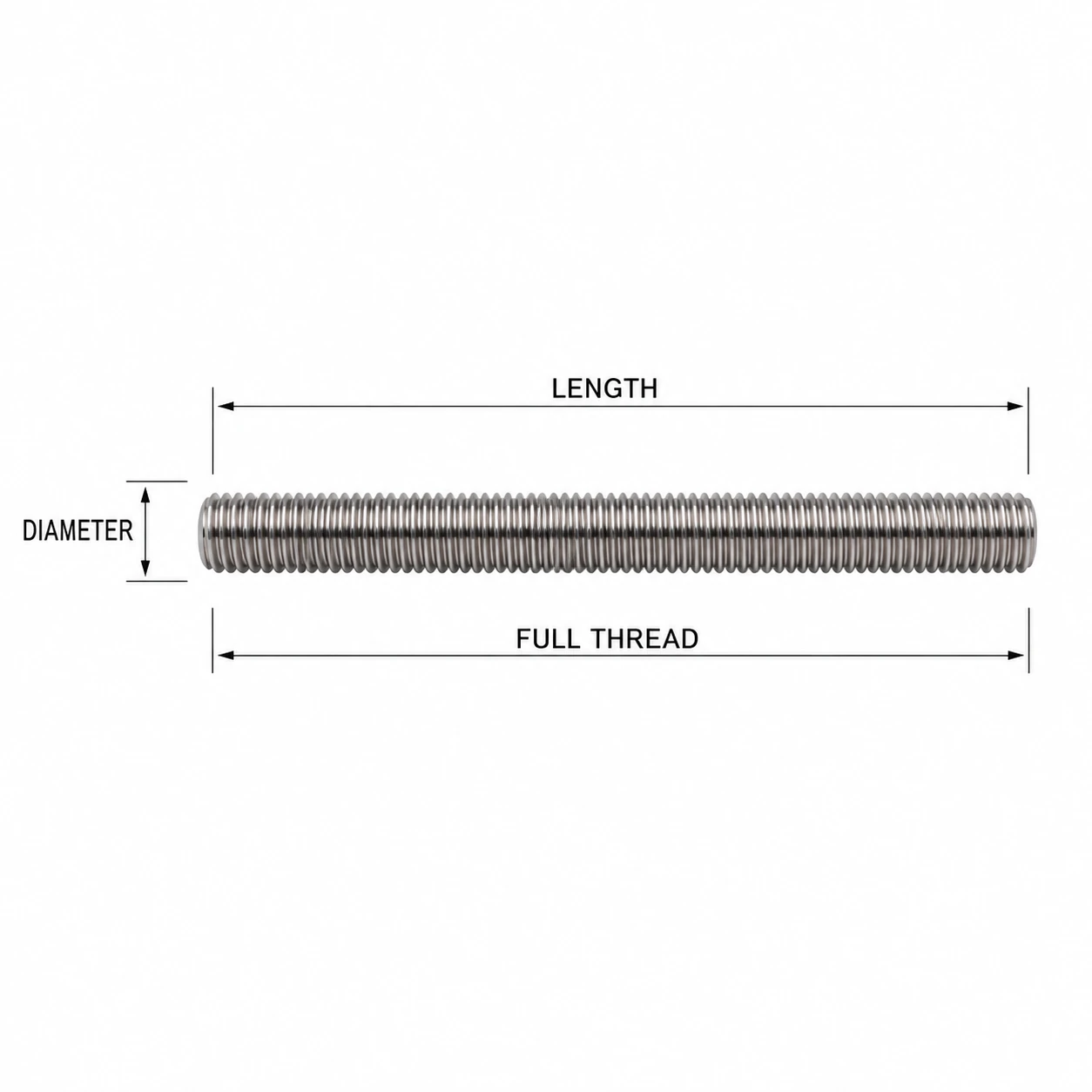
Most field problems with fully threaded rod are not related to nominal diameter. They come from details that are cheap to define at the inquiry stage and expensive to correct after delivery.
- Straightness. Long rods used in hanger runs or passed through several aligned holes are sensitive to bow. A straightness requirement should be stated where alignment matters, particularly for longer cut lengths.
- Cut ends and thread lead-in. Shearing or abrasive cutting can leave burrs, a skewed face or a damaged first thread, which prevents a nut from starting cleanly. Deburring, chamfering and an intact lead-in should be specified.
- Thread continuity. Confirm that the thread is continuous over the full usable length and that end portions carry a complete thread form where nuts need to run to the end.
- Length tolerance and cutting method. Factory-cut lengths and field-cut lengths have different implications. Field cutting can expose bare metal or disturb a coating or passivated surface, so the cut end may need a defined protective treatment.
- Coating and fit. Any applied finish changes the effective thread fit. Where a coating is required, the thread tolerance and the coating thickness should be considered together; see Coating Thickness and Dimensional Fit.
- Batch consistency and identification. For projects with inspection or traceability requirements, marking, labelling and lot identification should be included in the RFQ.
One sentence covering end finish and straightness in the RFQ costs nothing. Resolving the same point after the rods are on site rarely does.
How to Specify in an RFQ
A clear inquiry lets a supplier quote the same product the designer intended, and makes competing quotations comparable. Include the following:
- State the product form: continuously threaded rod, double-end stud or stud bolt.
- Give the governing standard number and revision, or attach the revision-controlled drawing.
- State nominal diameter, pitch and thread tolerance class.
- State cut length, length tolerance and whether cutting is factory or field.
- State the exact material grade and mechanical property class.
- Define surface condition: passivation, coating or as-supplied finish.
- Define end finish, thread lead-in and straightness requirements.
- State quantity, packing, protection and marking requirements.
- List inspection and documentation requirements where the project specifies them, including any material certification.
- Describe the service environment and any design constraints, and identify whether alternative grades require written approval.
For a broader view of inquiry preparation, see the Industrial Fastener RFQ Checklist and Fastener Specification Risks Before Production.
Typical Applications
- Pipe supports and hanger assemblies. Continuous thread allows the hanger height to be set and adjusted on site with nuts at each end.
- Steel fabrication and tie-rod assemblies. Long-span bracing and tie applications use rod where a standard bolt cannot provide the required length.
- Equipment base mounting and levelling. Adjustable nuts support alignment before final tightening.
- Facade and cladding support systems. Brackets and stand-off assemblies use threaded rod where the projection varies across the building envelope.
- General machinery and enclosure assemblies. Through-bolted and spaced joints benefit from a rod that can be cut to the assembly depth.
In each case the same rule applies: the thread, grade and dimensional requirements should be fixed by the design and stated in the inquiry, and any load-bearing suitability confirmed against the applicable product data and project design.
FAQ
Is fully threaded rod the same as threaded bar?
The terms are often used interchangeably, but not consistently across markets. Some suppliers use “threaded bar” for a construction-grade product with different thread or material assumptions. Reference a drawing or named standard rather than relying on the product name.
Do I need to state the pitch if the thread is coarse?
Yes. Stating the pitch explicitly removes ambiguity between coarse and fine series of the same nominal diameter and confirms the mating nut will be compatible.
Can A2 and A4 stainless rod be identified visually?
Generally no. Appearance is not a reliable way to distinguish stainless groups or property classes. Material documentation or suitable verification methods are used where the distinction is critical.
Does a higher property class mean better corrosion resistance?
No. Property class describes mechanical performance; corrosion behaviour depends on the material and its environment. The two requirements should be specified separately.
Can VALTOR review non-standard lengths or grades?
VALTOR can review requirements based on the drawing, applicable standard, grade, quantity and documentation needs. Share the relevant details in an RFQ so the requirement can be assessed against the specific order.
Need Fully Threaded Rod or Technical Support?
Share your drawing, standard, grade and dimensional requirements with VALTOR.