
Why the Thread Manufacturing Method Matters More Than Most Drawings Show
Most fastener drawings tell the manufacturer what thread geometry is required. They rarely explain how that thread should be produced. For a conventional standard fastener, that may be completely acceptable. But for custom hardware, special alloys, precision shoulders, fatigue-sensitive parts or unusual geometry, the manufacturing method can become part of the engineering decision. Rolling forms material; cutting and other machining methods remove it. These routes can affect feasibility, thread-root condition, process sequence, tooling, cost and repeatability. This article explains when the thread manufacturing route matters—and when buyers do not need to over-specify it.

1. The Drawing Defines Geometry — the Process Creates It
A thread callout normally defines nominal diameter, pitch, thread form and tolerance or class. Together with thread length, material and finish, these requirements describe the part the buyer expects to receive. They do not necessarily specify how the thread must be produced.
Two parts can meet the same thread specification while following different manufacturing routes. For an ordinary standard fastener, leaving that choice to a capable manufacturer can be entirely appropriate, provided the applicable product standard does not impose a process requirement and the finished product meets its acceptance criteria.
For custom hardware, geometry alone may not settle the decision. The location of the thread, material condition, loading, heat treatment, quantity and available tooling can all affect which route is practical. Distinguish the required finished result from any process restriction before requesting a quotation.
Key Takeaways
- Thread geometry and thread manufacturing method are different specification layers.
- Thread rolling forms material rather than removing it.
- Machined or cut threads can be the practical choice for custom or low-volume parts.
- Material condition, geometry and production quantity can change the best thread-making route.
- Thread roots, runout and shoulder transitions deserve attention in critical applications.
- Buyers should specify a manufacturing method only when it is functionally or contractually important.
2. What Thread Rolling Actually Does
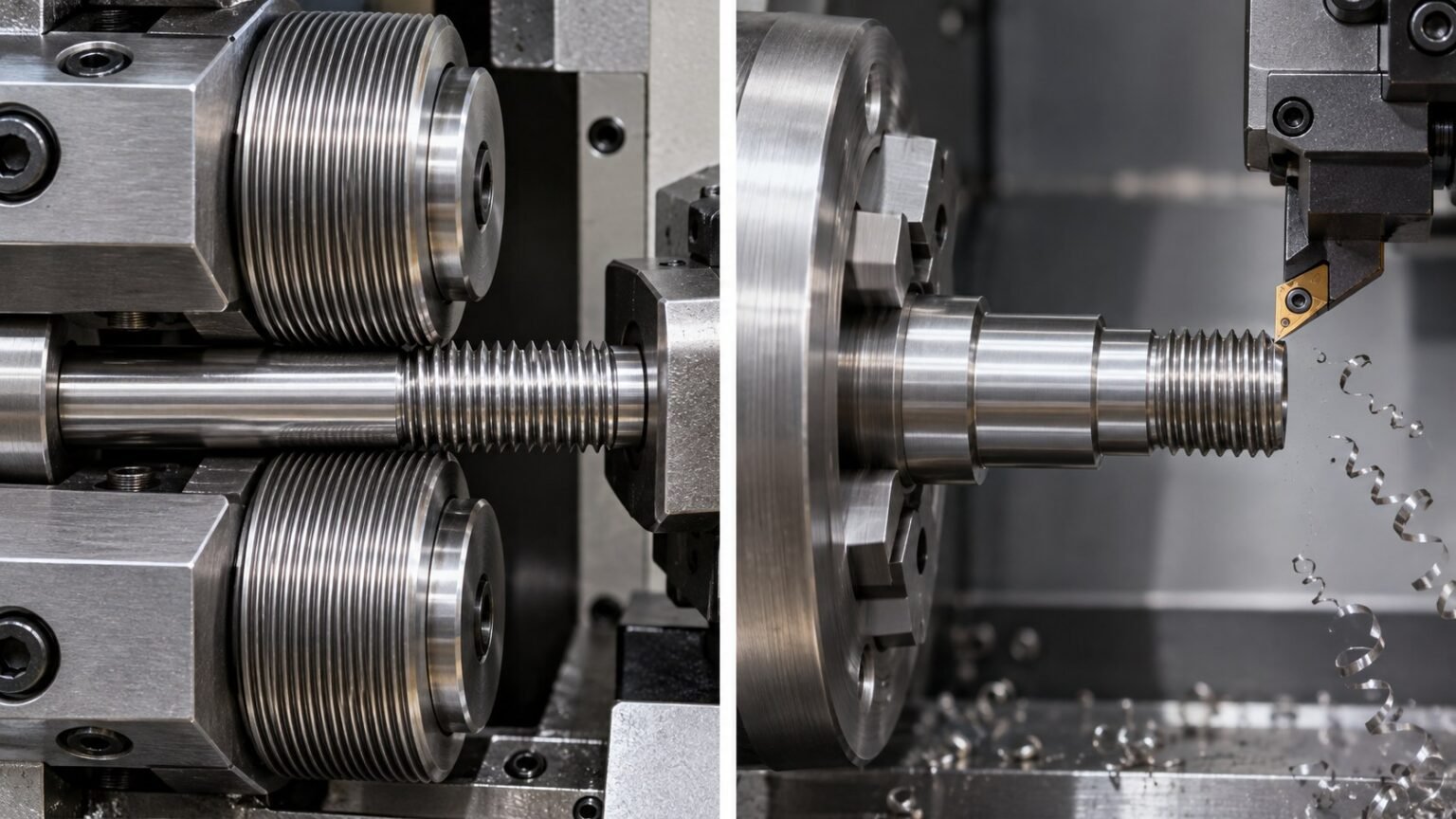
Thread rolling creates the profile by plastically deforming the workpiece surface. The dies displace material into the thread form rather than remove that material as chips. The starting workpiece and tooling must be suitable for this forming operation.
Where material, geometry and production demand are appropriate, rolling supports efficient repeat production and consistent thread formation. It can fit naturally into the production of cold-formed fasteners. Those manufacturing advantages do not establish universal mechanical superiority over a machined thread.
Actual performance depends on material, material condition, thread geometry, forming quality, heat treatment, surface condition and the final application. A process name is not a substitute for verifying these requirements. Buyers should ask how the proposed route will be controlled, not assume that the word “rolled” proves a particular strength or fatigue result.
Thread rolling is a forming process. The workpiece diameter, material condition and tooling must be appropriate for the required thread geometry before rolling is selected as the manufacturing route.
3. Why the Blank Diameter Matters in Rolled Threads
A rolling blank should not be assumed to start at the finished thread major diameter. Material moves during profile formation, so the prepared diameter affects how the thread fills and the final dimensions that can be achieved.
Blank preparation is part of the rolling process and should be determined from the thread specification, material, tooling and machine setup. Diameter consistency, starting surface condition and alignment help the manufacturer maintain a repeatable process. There is no single blank-diameter formula that buyers should apply indiscriminately across different threads, materials and rolling systems.
The buyer implication is to identify the required thread and any special process controls while allowing the manufacturer to establish suitable blank preparation. A dimension on an intermediate blank should not accidentally conflict with the requirement for the finished component.
For standard fasteners, buyers normally do not need to specify the rolling blank diameter. It is a manufacturing-control issue unless the project has a special process requirement.
4. When Cut or Machined Threads Make More Sense
Cut or machined threads are not inherently a lower-quality alternative. Thread turning and other machining methods can be practical for prototypes, low-volume custom parts, unusual diameters, complex stepped components and threads integrated into a larger CNC-machined geometry.
If a part is already being turned or milled, producing its thread during the machining route may avoid a separate setup or dedicated rolling tooling. Machining may also offer a workable route where surrounding features restrict access for conventional rolling dies. Its suitability still depends on tool access, material behavior, surface requirements and the finished thread specification.
The trade-off is not simply “rolling for quality, machining for convenience.” Review total operations, tooling, inspection and repeatability. The practical route is the one that reliably produces the required part. For drawing-based geometries, see CNC Machined Parts and Custom Fasteners.
5. Thread Root Condition Can Matter
In repeated or cyclic loading, the thread root and its surrounding transitions can warrant closer engineering attention than in an ordinary static fastening application. Relevant considerations include root geometry, machining marks, forming quality, surface condition, runout and the transition into an unthreaded section.
Neither a dimensional gauge result nor a manufacturing-method label establishes fatigue suitability on its own. A poorly controlled formed surface is not automatically acceptable, and a properly specified machined thread should not be dismissed simply because material was removed during production.
For a fatigue-sensitive component, identify the applicable design requirements and agree whether additional surface, root or process verification is necessary. Any performance claim should relate to the actual component and qualified manufacturing condition, not a generic improvement percentage.
A thread can pass a dimensional gauge and still require additional engineering review when root condition, runout or cyclic loading is critical to the application.
6. Thread Runout and Shoulder Transitions Are Often Overlooked
Custom threaded parts frequently place a thread beside a locating diameter, bearing face, reduced section, shoulder or machined step. The drawing may show the thread reaching the shoulder without explaining where full thread form is required or where incomplete runout is permitted.
Manufacturing needs physical space for tooling, thread formation and tool exit. Depending on the route, die clearance, cutting-tool withdrawal or relief geometry can limit the first usable full thread. This can affect engagement length or prevent a mating part from seating against its intended face.
Possible responses include a thread relief, controlled runout, an agreed geometry adjustment, alternative tooling or machining instead of rolling. Each requires review against the component’s function: removing material near a transition is not automatically harmless, and simply extending the drawn thread may not make it manufacturable.
Specify the required full-thread length and its relationship to the mating face. Agree any relief or transition requirement before production; do not apply a universal relief dimension to every design.
If the first full thread must be extremely close to a shoulder, identify that requirement clearly. Tool access and thread runout should be reviewed before production rather than assumed from the drawing alone.
7. Material Choice Can Change the Process Decision
A geometry that is straightforward to produce in one material may need a different process review in another. Carbon steel, alloy steel, 304 stainless steel and 316 stainless steel do not have identical forming or machining behavior; their supplied condition also matters.
Special materials such as 2205 Duplex, 2507 Super Duplex, 904L, 1.4529 / UNS N08926 and C-276 / UNS N10276 deserve a grade-specific review. C-276 is a nickel-based corrosion-resistant alloy, not a stainless steel grade. Do not treat all corrosion-resistant materials as one manufacturing category.
Formability, work hardening, tooling load and machining behavior can influence the route. Diameter, thread length, quantity and available tooling may change the decision again. Special-alloy threads are not automatically excluded from rolling: manufacturing feasibility should be reviewed according to grade, material condition, geometry, size, quantity and available tooling.
Provide the material designation and required condition with the drawing, rather than only a trade description. See Stainless Steel & Special Alloy Materials for the material range to discuss during sourcing.
8. Heat Treatment Sequence Can Matter
Thread manufacturing cannot always be separated from the material and heat-treatment route. Process planning may need to consider thread formation before treatment, dimensional change during treatment, surface condition, final hardness and any secondary processing requirements.
A route selected only for ease of thread production may not suit the required final mechanical condition. Conversely, changing the sequence to solve a dimensional issue may alter tooling demands or a previously approved process. Do not assume that every thread must be rolled before heat treatment, or that the sequence is freely interchangeable.
Define the final material and mechanical requirements, then review how the proposed sequence achieves them. Where a qualified or customer-approved route is required, sequence changes should receive the applicable approval rather than being treated as a routine shop-floor substitution.
9. Coating Comes After the Thread — but Can Change the Final Fit
Where zinc plating, zinc flake, hot-dip galvanizing or another specified coating follows thread production, the final mating condition may change. The thread-making route creates the geometry; finishing influences the final surface and clearance.
Treat these as connected stages and define the condition in which final thread acceptance applies. For that separate fit-control issue, see When Coating Thickness Becomes a Dimensional Problem. Selecting rolling or machining does not, by itself, resolve coating allowance or finished mating requirements.
10. Quantity Can Change the Most Practical Route
For a prototype or very small order, a flexible machining route may avoid investment in dedicated rolling tooling and allow drawing changes during development. For repeated custom production, that initial tooling decision may look different when long-term demand is considered.
Dedicated forming and rolling routes are common in higher-volume standard fastener production where the geometry and material are suitable. They are not automatically the least-cost choice for every custom part. Setup, tooling availability, material, thread size, machine capacity, expected repeat orders and the complete manufacturing route all affect the economics.
Share realistic initial and repeat quantities with the supplier. Ask which costs relate to tooling and which relate to production, without assuming a fixed minimum quantity at which rolling must become preferable.
How Production Situation Influences Thread Manufacturing
| Production Situation | Route to Review |
|---|---|
| Prototype / very low quantity | Thread machining or flexible machining route |
| Low-volume custom component | Machining or rolling depending on geometry |
| Repeat custom production | Review rolling feasibility and tooling economics |
| High-volume standard fastener | Thread rolling commonly worth evaluating |
| Complex CNC component | Machined thread may integrate better |
| Special alloy component | Manufacturing feasibility review first |
11. When Should a Buyer Specify the Thread Manufacturing Method?
For ordinary standard fasteners, buyers often do not need to control whether the thread is rolled or cut if the applicable standard, performance and acceptance requirements are met. Check whether the product specification already controls the process before adding an independent drawing note.
Method control may be important when a drawing explicitly requires rolled threads, cyclic loading or root condition is critical, a project or aerospace/customer specification controls the route, or process validation and customer approval apply. A qualified production route may also need to remain unchanged for repeat orders.
Unnecessary process restrictions can reduce supplier options, increase development complexity and cost, or exclude an equally suitable route. When a restriction is necessary, make its scope clear: identify the controlled process, relevant sequence, validation or documentation, and how changes will be approved.
Specify the required result first. Specify the manufacturing method only when the process itself is part of the engineering, quality or contractual requirement.

12. Questions to Review Before Manufacturing a Custom Threaded Part
Use these questions to connect drawing review, manufacturing feasibility and final acceptance. Clarify the items relevant to the component before approving a route.
- What thread size, pitch and tolerance are required?
- Is the thread standard or special?
- What material and material condition are required?
- Is the part already being CNC machined?
- Is the thread close to a shoulder or another feature?
- Is cyclic loading important?
- Is a particular thread manufacturing method specified?
- Is heat treatment required?
- What coating or finishing will follow?
- What quantity and repeat demand are expected?
- How will the final thread be inspected?
- Is functional mating verification required?
The inspection plan should reflect the finished thread and its intended use. Dimensional gauging, engagement with an agreed mating component and any additional surface or process checks serve different purposes; choose the necessary checks rather than assuming one result covers them all.
13. Which Thread Manufacturing Route Should Be Reviewed?
This table is a starting point for review, not a process prescription. The applicable standard, engineering requirements and manufacturing feasibility take precedence over the general production examples.
| Situation | Manufacturing Route to Review | Main Reason |
|---|---|---|
| High-volume standard fastener | Thread rolling | Efficient repeat production when geometry and material are suitable |
| Low-volume custom component | Machined / cut thread | Flexible without dedicated rolling tooling |
| Complex CNC part | Thread machining | Can integrate with an existing machining process |
| Cyclic-load critical component | Engineering review of thread process | Root condition and process control may matter |
| Special alloy | Manufacturing feasibility review | Material behavior can change tooling and process choice |
| Thread very close to shoulder | Process / tooling review | Runout and tool access may control geometry |
| Repeat OEM component | Rolling vs machining comparison | Evaluate tooling against long-term production demand |
14. Select a Route That Meets the Complete Requirement
A thread specification defines the geometry. The manufacturing route determines how that geometry is created. For an ordinary standard fastener, the buyer may never need to know whether the thread was rolled or machined. For a custom component, special alloy or functionally critical thread, the process can become part of the engineering decision.
The best method is not automatically rolling or machining. It is the route that reliably meets the required geometry, material condition, performance, quantity and production requirements. Review the complete component and its process sequence, then specify only the controls that the application genuinely needs.
FAQ
Are rolled threads always stronger than cut threads?
No universal statement should be made without considering material, heat treatment, geometry, process condition and application. Rolled and machined threads are different manufacturing routes, and either may be appropriate depending on the requirement.
Why are threads commonly rolled on standard fasteners?
Thread rolling is well suited to repeat fastener production where the material, geometry and volume are appropriate. It forms the thread efficiently without cutting away material from the thread profile.
When are machined threads a better choice?
Machined threads can be practical for prototypes, low-volume production, complex CNC components, unusual geometry or designs that do not suit conventional thread rolling equipment.
Can stainless steel threads be rolled?
Yes, many stainless fasteners use rolled threads. Feasibility depends on the specific grade, material condition, geometry, thread size, tooling and production process.
Why does thread location near a shoulder matter?
Rolling or cutting tools require working space and runout. If full thread engagement is required very close to a shoulder, the manufacturing route and relief geometry should be reviewed before production.
Should buyers specify rolled threads on every drawing?
Usually not. The manufacturing method should be specified when it is required by the engineering design, quality plan, applicable specification or customer requirement. Otherwise, defining the required finished result may allow the manufacturer to select the most suitable process.
Need to Review a Custom Threaded Part?
Share your drawing, material, thread requirement, quantity and application details with VALTOR for manufacturing feasibility review.